Tasbih After Salah: The 33-33-34 Dhikr and How to Count It
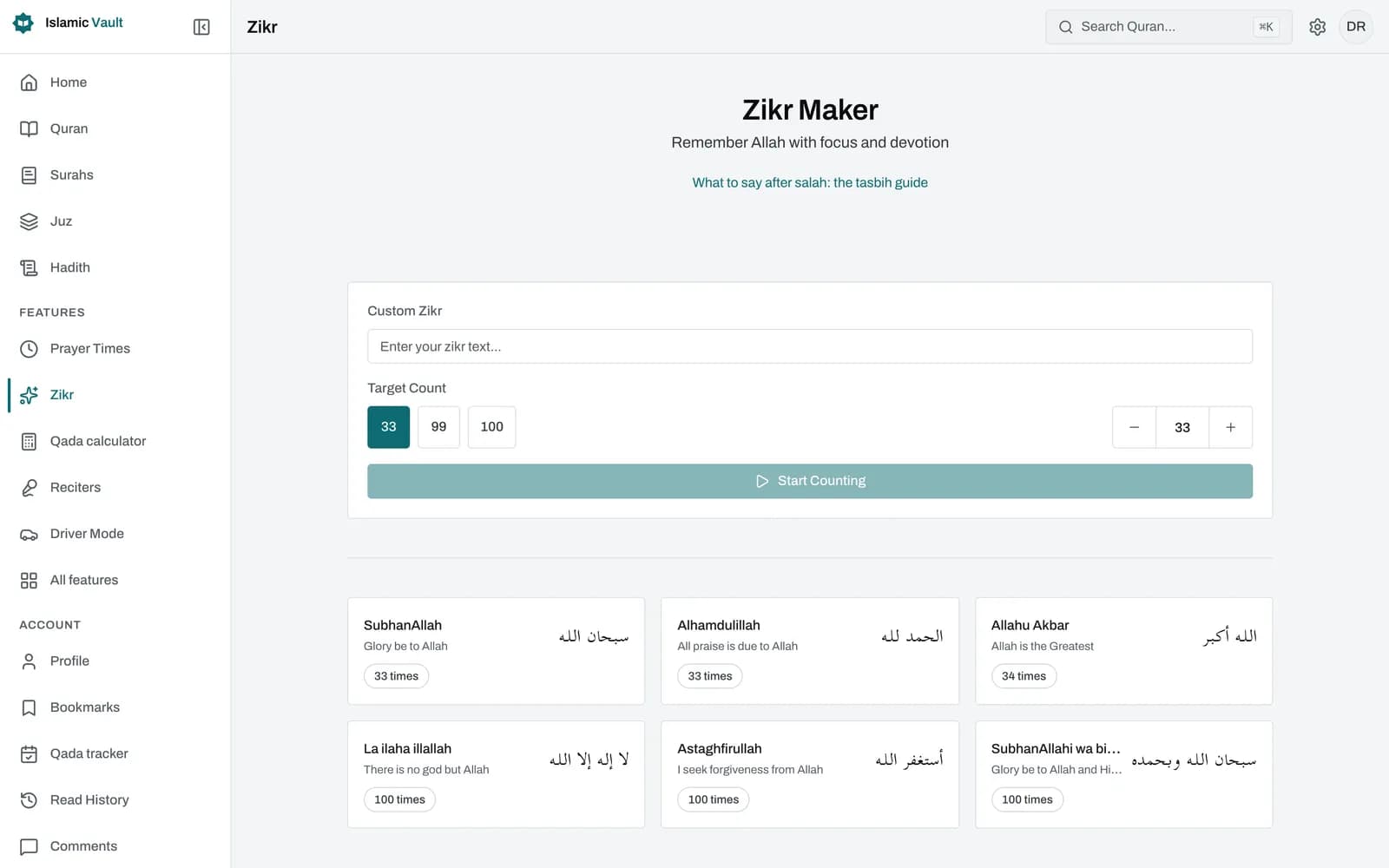
After each obligatory prayer, say SubhanAllah 33 times, Alhamdulillah 33 times and Allahu Akbar 34 times, as taught in Sahih Muslim. Our free Zikr Maker counts it for you on any screen: tap to count, watch the ring fill, and save your favourite adhkar with a free account.
How it works
- 1
Choose a dhikr
Pick one of six presets, such as SubhanAllah with a target of 33, or write your own zikr and set a target from 1 to 10,000.
- 2
Tap to count
Tap the large circle for each repetition. The counter shows how far you are, and Undo removes a tap if you miscounted.
- 3
Reach your target
When you hit the target, a completion screen appears with "MashaAllah". Choose Do Again, or go back and start the next dhikr.
- 4
Save it, if you like
Signed in, tap the heart to keep a zikr in My Saved Zikr. Each completed count is added to your history automatically.
What do you say after salah?
After every obligatory prayer, a well-known sunnah is to say SubhanAllah (Glory be to Allah) 33 times, Alhamdulillah (All praise is due to Allah) 33 times and Allahu Akbar (Allah is the Greatest) 34 times. Together that makes 100 phrases of remembrance after each prayer, a short act of worship that fits into any day.
The source is a narration from Ka'b ibn 'Ujra in Sahih Muslim 1349 (numbered as in our hadith collection). He reported the Messenger of Allah (ﷺ) as saying that whoever repeats these phrases after every prescribed prayer "will never be caused disappointment": glory be to Allah thirty-three times, praise be to Allah thirty-three times, and Allah is most Great thirty-four times.
In Zikr Maker, the first three presets match this sequence exactly. The app does not move from one phrase to the next on its own, so you start each of the three counters yourself, one after the other.
Is the tasbih after prayer 33-33-34 or 33 each?
Both are authentic. One narration in Sahih Muslim gives 33, 33 and 34, which makes 100. Another, from Abu Huraira in Sahih Muslim 1352, gives 33 of each, 99 in all, then completes the hundred by saying "There is no god but Allah" with the words that follow it in the hadith.
You can follow either pattern. To use the 33-each version in the app, start SubhanAllah and Alhamdulillah as usual, then count Allahu Akbar as a custom zikr with a target of 33 and finish with La ilaha illallah as a custom zikr with a target of 1.
A related narration in Sahih al-Bukhari 5362, from Ali ibn Abi Talib, gives the same 33, 33 and 34 at bedtime, in a story involving Fatimah. This is why many people call it the Tasbih of Fatimah. That narration is about bedtime, not specifically after salah.
Which adhkar are in the counter and what do they mean?
Zikr Maker includes six common adhkar, each shown in Arabic with a transliteration and English meaning. Three follow the after-salah sequence with targets of 33, 33 and 34, and three are longer remembrances with a target of 100. You can also type any other zikr and give it your own target.
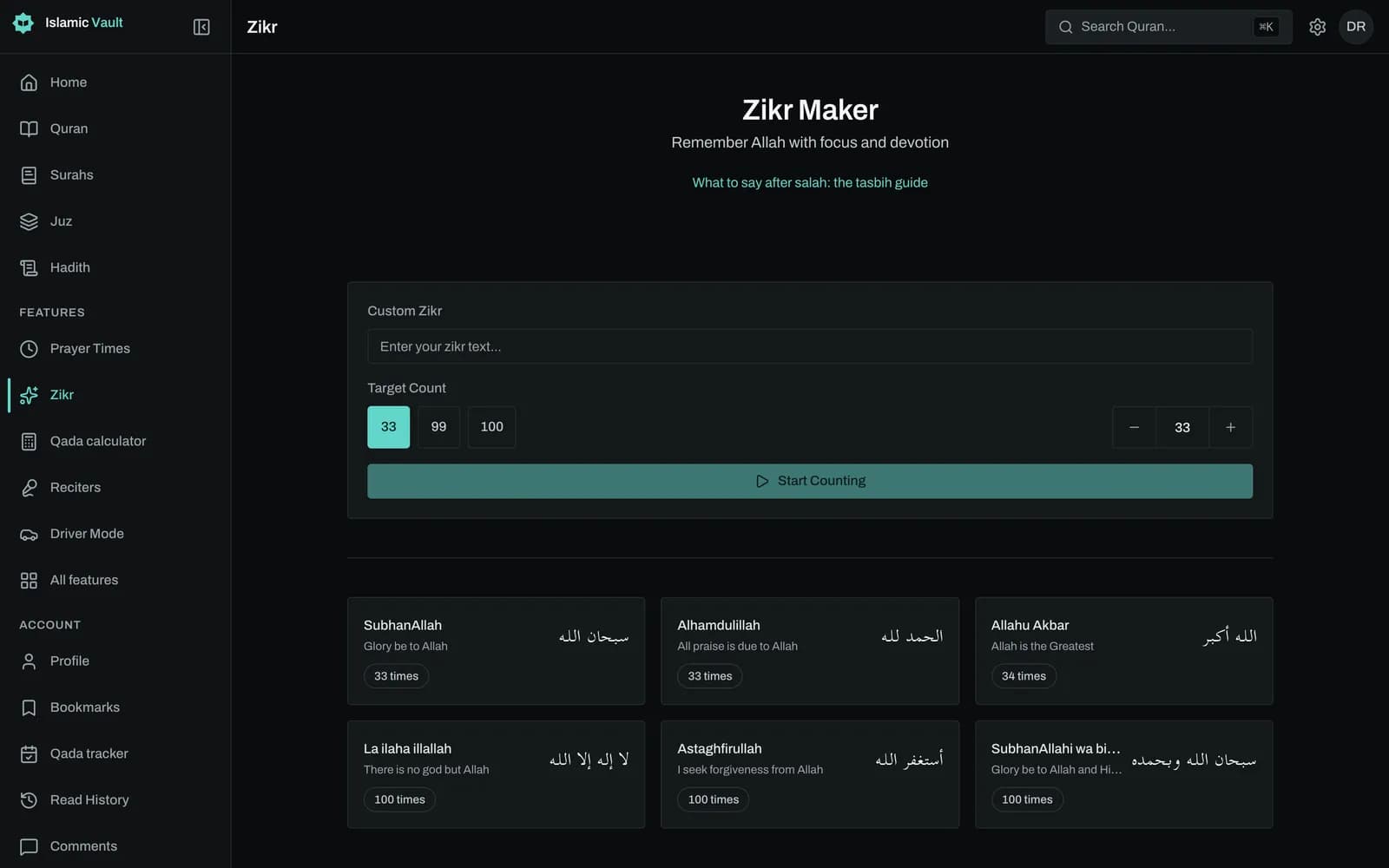
The presets are: SubhanAllah (Glory be to Allah), 33. Alhamdulillah (All praise is due to Allah), 33. Allahu Akbar (Allah is the Greatest), 34. La ilaha illallah (There is no god but Allah), 100. Astaghfirullah (I seek forgiveness from Allah), 100. SubhanAllahi wa bihamdihi (Glory be to Allah and His is the praise), 100.
For a custom zikr, quick buttons set a target of 33, 99 or 100, or you pick any number from 1 to 10,000. A custom zikr is saved as you typed it, without a separate Arabic field.
How do you count dhikr with presence of heart?
Counting is a help, not the goal. Say each phrase slowly enough to mean it, and let the counter carry the number so your attention can stay on the words and on Allah. A quiet place, a steady pace and knowing the meaning of what you say all make the remembrance fuller.
Many people count on their fingers or with prayer beads; a digital tasbih is simply another way to keep track. The hadith above specify the numbers, not the counting method. For detailed rulings on how and when to make dhikr, ask a scholar you trust. This page is general guidance, not a fatwa.
How do I save my zikr and see my history?
Create a free account and sign in. You can then tap the heart in the counter to keep any zikr in My Saved Zikr, and every count you complete is added to your History. Without an account the counter still works fully, but nothing is saved and reloading the page clears the count.
History lists your 20 most recent completed sessions, each with the text, how many times you said it and when. Only finished counts are logged; a count you stop halfway is not saved.
Saved zikr can be started again with one tap or removed. The counter keeps things simple on purpose: there are no streaks, daily totals, reminders, sounds or vibration.
Sources and method
Frequently asked questions
What do I say after salah (tasbih after prayer)?
Say SubhanAllah 33 times, Alhamdulillah 33 times and Allahu Akbar 34 times after each obligatory prayer, as narrated in Sahih Muslim 1349. In Zikr Maker these are the first three presets, each with the right target already set.
Is the tasbih after prayer 33, 33 and 34 or 33 each?
Both are narrated in Sahih Muslim. One gives 33, 33 and 34. The other gives 33 of each and completes the hundred with La ilaha illallah (There is no god but Allah) and the words that follow it. Either pattern is a sound way to make dhikr after salah.
What is the Tasbih of Fatimah?
It is the name many people give to SubhanAllah 33, Alhamdulillah 33 and Allahu Akbar 34. Sahih al-Bukhari 5362, narrated by Ali ibn Abi Talib in a story involving Fatimah, mentions this sequence at bedtime. The same numbers appear after prayer in Sahih Muslim 1349.
Do I need prayer beads or can I use a tasbih app?
You do not need beads. The narrations give the numbers, not a counting tool. A digital tasbih such as Zikr Maker is free, works in any browser on phone or computer, and helps you keep count without looking away from your dhikr.
Can I count tasbih on my fingers?
Yes, many Muslims count dhikr on their fingers, and others prefer beads or an app. Use whatever helps you stay focused on the words. If you want guidance on a preferred method, ask a scholar you trust.
Do I recite the tasbih after sunnah prayers too?
The narrations quoted here mention every prescribed, obligatory prayer. Whether to repeat it after sunnah prayers as well is a question of scholarly detail, so ask a scholar of your madhhab. This is general guidance, not a fatwa.
Does the counter remember my count if I close the page?
No. An unfinished count is not saved, for guests or signed-in users. With a free account, each count you finish is logged in your History, and zikr you save with the heart stay in My Saved Zikr for next time.
Related features
Read all 114 surahs of the Quran online in Arabic with English translation and transliteration. Choose from 50+ translations in 30+ languages, free.
Search 40,762 hadith from Sahih al-Bukhari, Sahih Muslim and seven more collections by keyword, in Arabic or English, with grades shown. Free, no sign-up.
Estimate how many qada prayers you owe, set a daily goal and track every prayer you make up. Free qada (qaza, qadha) tracker in 13 languages.
Keep your progress in one place
Create a free account to save your progress and pick up where you left off. Or start exploring now, no account needed.