Qada Prayer Tracker: Make Up Missed Prayers, One Day at a Time
You make up years of missed prayers the same way you build any habit: estimate the total once, then pray a steady number of qada prayers every day. Our free calculator gives you the estimate, and the tracker turns it into a daily goal, a projected finish date and a visible record of progress.
How it works
- 1
Estimate your total
On the qada calculator, choose your madhhab and enter when you reached adulthood and when you started praying regularly. No account needed.
- 2
Save it to your tracker
Tap Save and track and create a free account; the estimate becomes your starting total. You can also enter known numbers directly.
- 3
Set a daily goal
Pick 1 to 20 full days of qada per day. The tracker projects a finish date and shows whether your last seven days are on track.
- 4
Log as you pray
Tap plus on a single prayer or log a whole day at once, with undo. Your streak, charts and milestones update straight away.
What are qada prayers and why make them up?
Qada (also spelled qaza or qadha) means making up an obligatory prayer that was not prayed in its time. Many Muslims carry years of missed salah, often from before they began praying regularly, and making them up is a way of returning to a duty the Quran describes as tied to fixed times.
The Quran says: "surely the prayer is a timed prescription for the believers" (Surah An-Nisa 4:103, Arberry translation). The verse speaks about prayer having set times; the detailed rules for making up missed prayers come from the scholars of each school, not from this verse alone.
This page is general guidance, not a fatwa. For your own situation, ask a scholar of your madhhab.
How do I calculate how many prayers I missed?
Count every day from the date you reached adulthood (bulugh) until the date you started praying regularly, then multiply by the prayers owed per day. The free qada calculator does this for you: it treats each of those days as one missed Fajr, Dhuhr, Asr, Maghrib and Isha, plus witr if you count it.
The calculator sets the bulugh date from your date of birth and an age of adulthood (15 by default, adjustable from 9 to 20), or you enter the date directly. Only obligatory prayers count, never sunnah.
For women, the calculator allows for menstruation with a monthly average: for each prayer it deducts the days in the range times your usual period length (7 by default, adjustable), divided by 30. It is not exact cycle tracking, and postnatal bleeding is not modelled.
The result shows a per-prayer breakdown, the total and the missed days, with a reminder that it is an estimate and you should ask a scholar about your own situation.
Do the madhhabs count qada prayers differently?
The main difference the calculator reflects is witr. In the Hanafi school witr is wajib, so it is counted by default and you owe six prayers per missed day. The Shafi'i, Maliki and Hanbali schools consider witr sunnah, so the default is five. Either way, you can switch witr on or off yourself.
Choosing a madhhab in the calculator only presets the witr switch. It does not change the dates, the age of adulthood (15 by default for all four schools) or anything else in the arithmetic. If you are not sure which school to choose, pick the one your local mosque follows.
What is a realistic plan to make up missed prayers?
A common, sustainable plan is to pray one qada prayer alongside each fard prayer, which clears one full day of missed prayers every day. If that feels easy, raise the goal to two or three days. Consistency matters more than speed, so choose a pace you can keep for months.
Example: say you missed three years (1,095 days) and owe five prayers a day: that is 5,475 prayers. At one full day of qada per day you finish in 1,095 days, about three years. At two full days per day it takes 548 days, about 18 months. At three it takes 365 days, one year.
With witr counted the total is 6,570, but a full day then holds six prayers, so the days to finish stay the same. The tracker works these dates out from your real remaining total.
How does the Islamic Vault qada tracker work?
The tracker keeps your remaining qada prayers per prayer, lets you log each one as you pray it, and shows progress over time. It needs a free account so your numbers are saved and synced to it. Guests can use the calculator, but nothing is stored until they sign up.
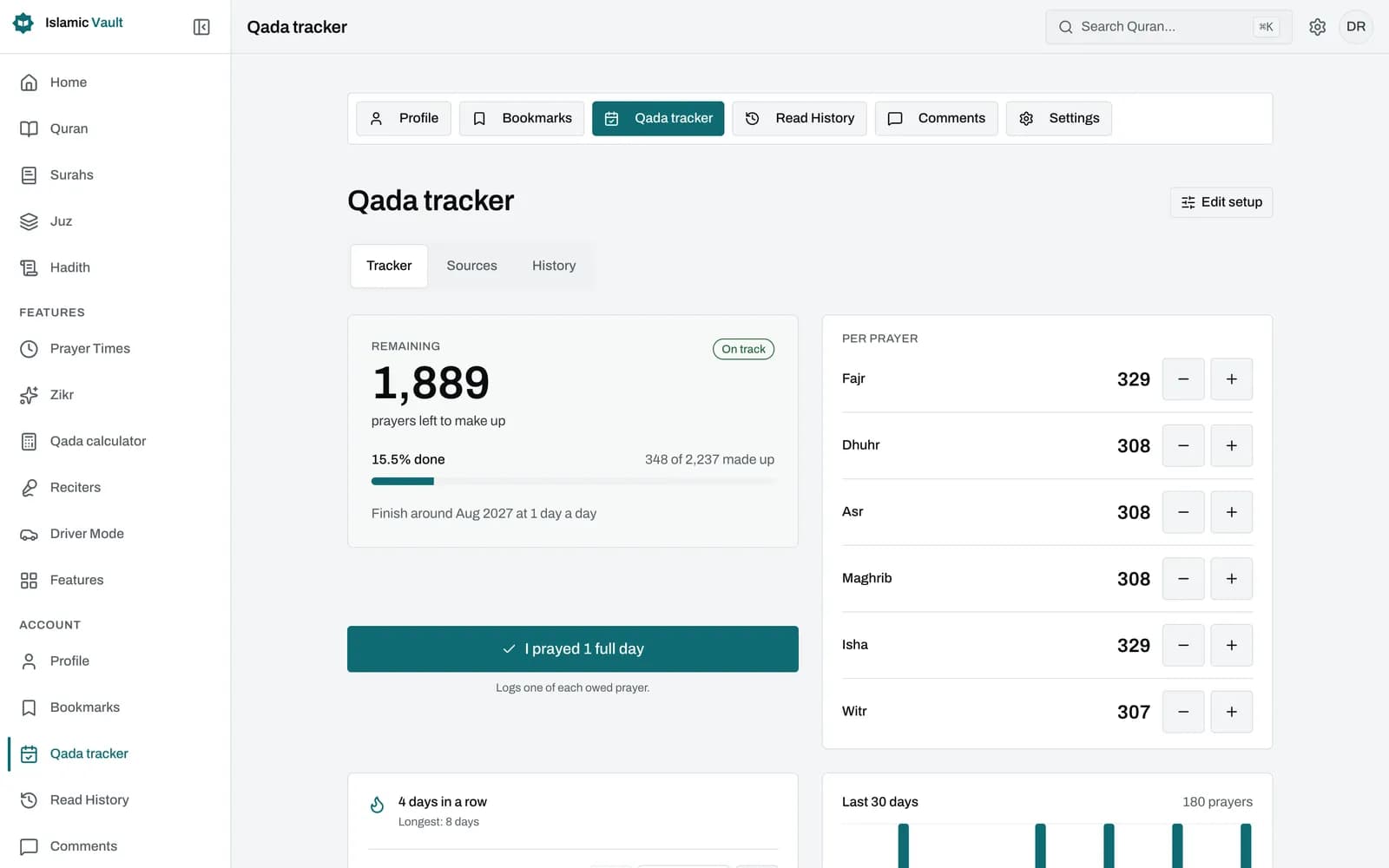
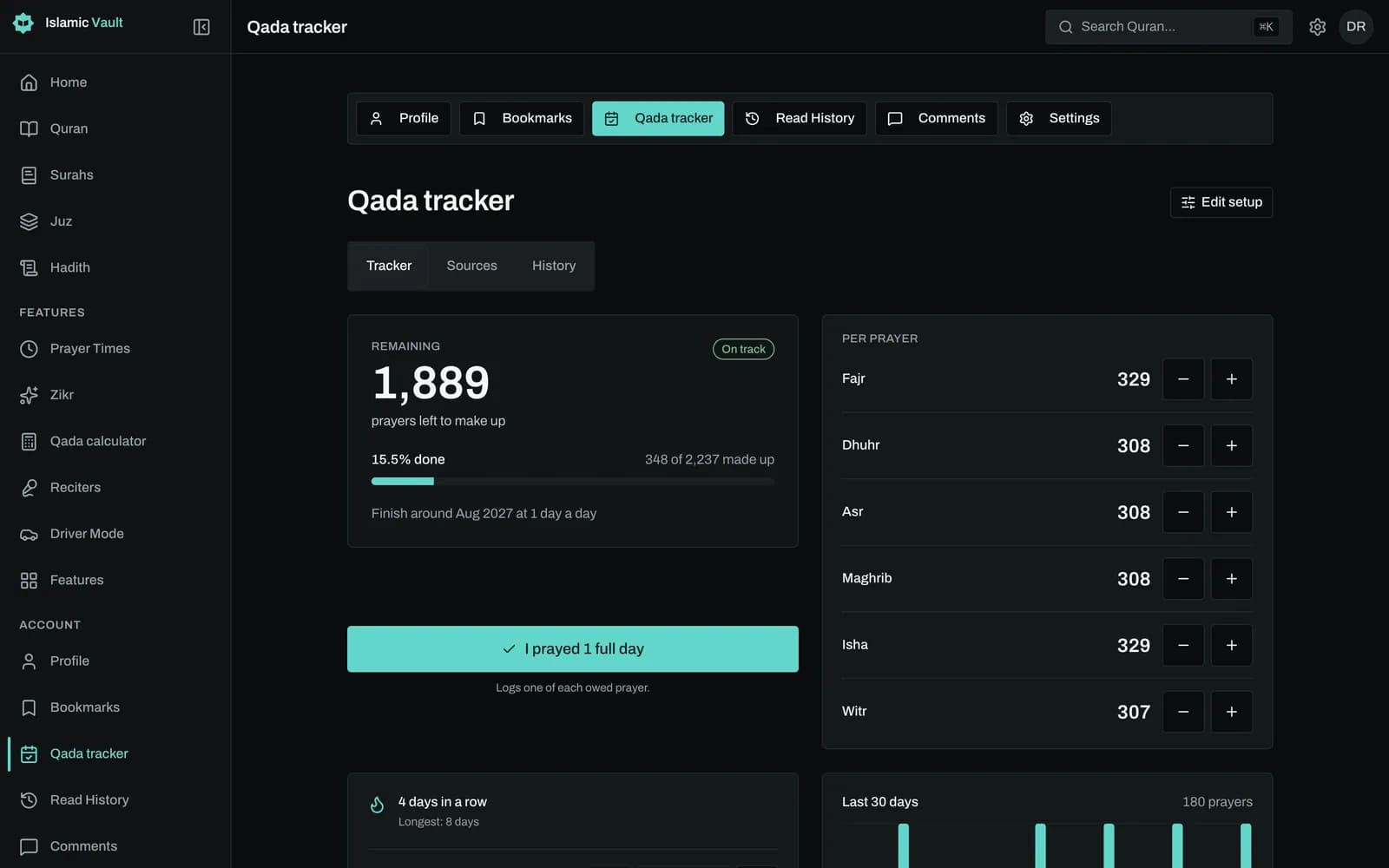
The dashboard shows the remaining total, the percentage made up and the count per prayer, with plus and minus buttons and an "I prayed 1 full day" shortcut. When you finish it says "Alhamdulillah, all made up".
A daily goal of 1 to 20 full days sets your projected finish date. Your streak, a 30-day bar chart and a 12-month heatmap show your rhythm, and a short du'a marks 10, 25, 50, 75 and 100 percent.
On the sources page you can add a period, single days or a manual adjustment; overlaps are never counted twice. The history page lists every log by date. Qada screens are not in the mobile app yet, and there are no reminders.
Sources and method
Frequently asked questions
How do I keep track of my missed prayers?
Get an estimate from the qada calculator, then save it to the tracker with a free account. Each time you make up a prayer, tap plus next to it or log a full day at once. The history page lists every entry by date.
How many missed prayers should I make up per day?
There is no fixed number. A common start is one full day per day: one extra prayer with each fard. In the tracker you set a goal from 1 to 20 full days and see how it moves your finish date.
Can I make up several qada prayers in one sitting?
The tracker lets you log up to 50 of one prayer in a single tap, or up to 10 full days at once. How to pray them in one sitting is a fiqh question; ask a scholar of your madhhab.
In what order should I pray qada prayers?
The tracker does not enforce an order: you log whichever prayer you made up. Whether a particular sequence is required is a question for the scholars of your school, so ask a scholar of your madhhab.
Is there a free app to track qada prayers on my phone and computer?
Yes. The Islamic Vault calculator and tracker are free and run in any browser, on phone or computer, with your tracker saved to your account. The iOS and Android apps do not have qada screens yet.
What if I do not know exactly how many prayers I missed?
Most people do not, so the calculator works from two dates: adulthood and when you began praying regularly. Use your best honest estimate, then add specific periods or days, or adjust a count with a note, as you remember more.
Does the tracker include missed fasts?
No. The tracker counts the five daily prayers and, if you choose, witr. It does not track missed fasts, fidyah or kaffarah, and it does not handle shortened travel prayers. Sunnah prayers are never counted.
Related features
After salah: SubhanAllah 33, Alhamdulillah 33, Allahu Akbar 34, with the hadith source and a free digital tasbih that works in any phone or computer browser.
Mark every ayah and surah you read, see your percentage and streak, and track your khatam. Free Quran reading tracker on web, iOS and Android in 13 languages.
Read all 114 surahs of the Quran online in Arabic with English translation and transliteration. Choose from 50+ translations in 30+ languages, free.
Keep your progress in one place
Create a free account to save your progress and pick up where you left off. Or start exploring now, no account needed.