Hadith Narrators: Read the Hadith of Abu Huraira, Aisha and Other Companions
Islamic Vault lets you read hadith by the person who narrated them. Open a narrator such as Abu Huraira or Aisha and you see the hadith in our collections linked to their name, 50 per page, each linked to the full hadith. It is free, works in the browser and needs no account.
How it works
- 1
Open the narrator list
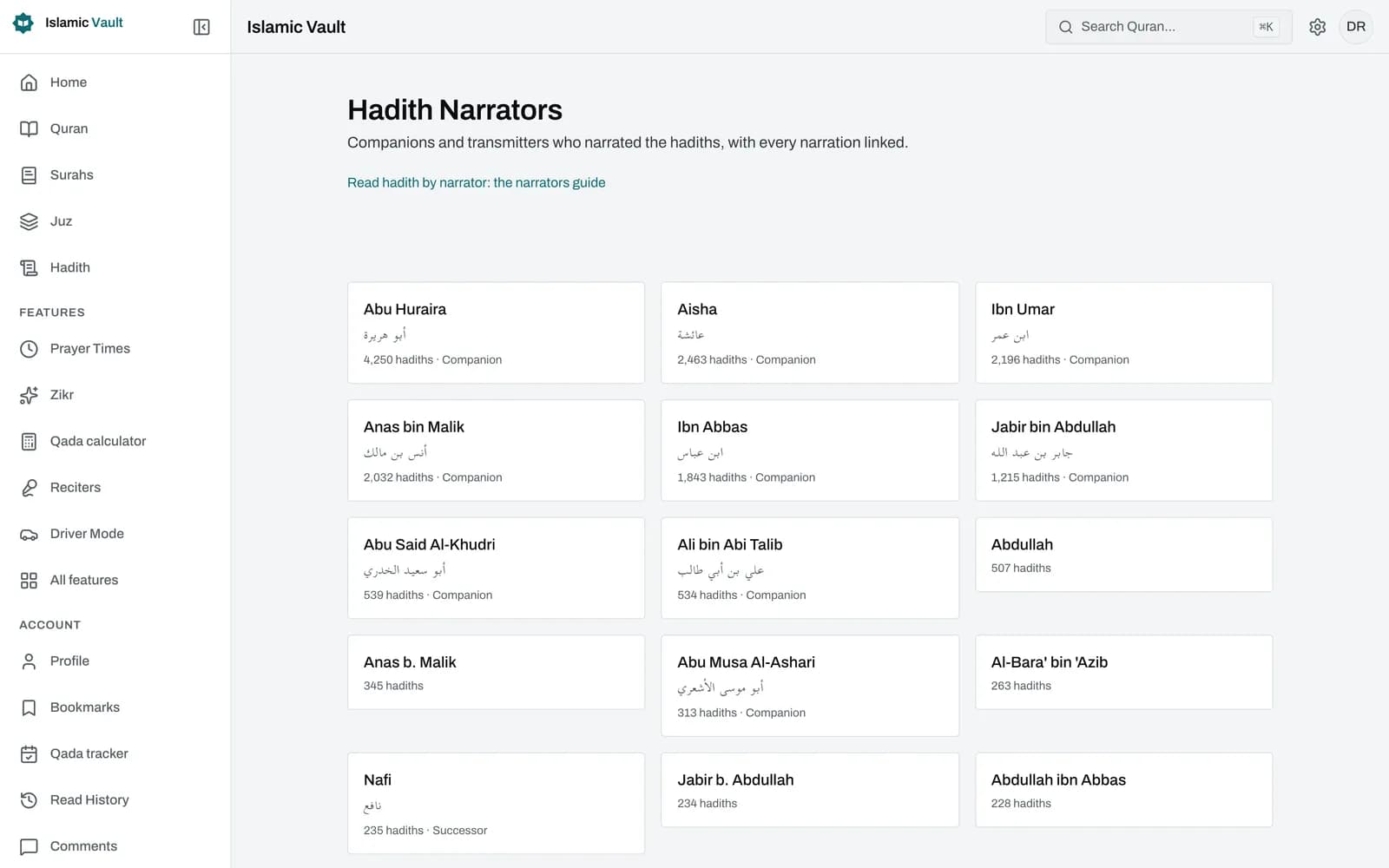
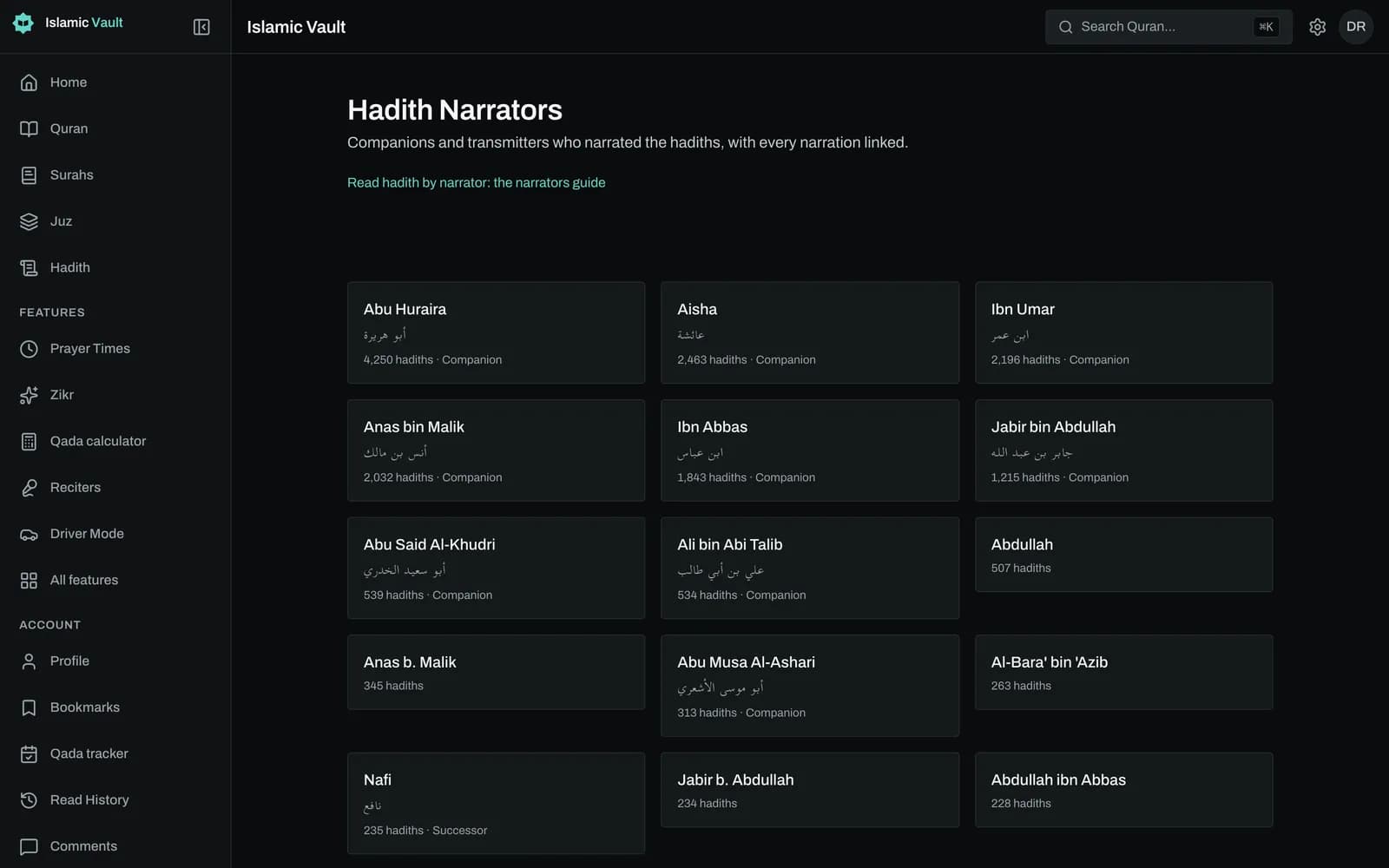
Go to Narrators. Entries are ordered by how many hadith are linked to them, so the most-narrated Companions appear first.
- 2
Choose a narrator
Tap a name such as Ibn Umar or Anas bin Malik. The page shows the English name, the Arabic name where we have it and the number of linked hadith.
- 3
Read their hadith
Scroll the list of hadith cards, 50 per page. Each card shows which collection it comes from.
- 4
Go to the full hadith
Tap a card to open that hadith in its collection, where you can read it in context and keep exploring.
What is an isnad, and why do narrators matter?
An isnad is the chain of people who passed a hadith on, from the Prophet (peace be upon him) to the scholar who recorded it. Muslims have always weighed a hadith by its narrators as well as its text, which is why knowing who narrated what has been central to hadith study for centuries.
A hadith has two parts: the isnad (also called sanad), the chain of narration, and the matn, the wording that was narrated. Scholars examined the people in each chain, asking whether they were truthful, whether their memory was sound and whether they could have met the person they narrated from. This discipline is known as ilm al-rijal, the knowledge of the men and women of hadith, and its assessment of narrators is called jarh wa ta'dil.
Islamic Vault does not reproduce that scholarly work. What it offers is a simpler, practical view: the narrator named at the start of a hadith, usually the Companion who heard it from the Prophet, and the hadith in our collections linked to that name.
Which Companions narrated the most hadith?
In Islamic Vault's collections, Abu Huraira is linked to the most hadith, 4,250, followed by Aisha with 2,463, Ibn Umar with 2,196, Anas bin Malik with 2,032 and Ibn Abbas with 1,843. These figures count hadith linked to each name in our collections, not every chain the narrator appears in.
Next come Jabir bin Abdullah (1,215), Abu Said Al-Khudri (539), Ali bin Abi Talib (534) and Abu Musa Al-Ashari (313). The order broadly matches what students of hadith learn, but our numbers are specific to the collections in the app and to how we link narrators, so they will not match totals quoted in classical works.
The count is based on the first-named narrator. If Abu Huraira appears deeper in a chain, or the hadith opens with a different name, it is not included in his 4,250.
How do I read a narrator's hadith in Islamic Vault?
Open Narrators, choose a name and read down the list. Each narrator page shows the English name, the Arabic name for the leading narrators, the number of linked hadith, followed by the hadith themselves, 50 per page. Names appear in English spelling.
Each hadith card links to the full hadith in its collection. The list mixes collections, so one narrator page can bring together narrations from several different books.
Please read the list with its limits in mind. We have over 4,900 narrator entries, but only the most-narrated Companions have been merged and labelled carefully. Further down the list you will find spelling variants, duplicates and fragments. Only 20 entries carry a generation label, and Nafi is the only Successor tagged so far. There is no search box on the narrator list yet, and there are no biographies, dates or reliability ratings.
How do narrator pages connect to hadith search?
Narrator pages and hadith search are two ways into the same hadith. Search finds hadith by their words; a narrator page gathers hadith by the person who narrated them. Every card on a narrator page opens the full hadith, so you can move from a Companion to a single hadith and its collection.
Coverage differs by collection. Almost every hadith in Sahih al-Bukhari is linked to a narrator (7,560 of 7,580), while Musnad Ahmad is only partly linked (338 of 1,374) and Sunan ad-Darimi is not linked at all yet. Overall about 86% of the hadith in the app are linked to a narrator.
Browsing narrators and reading hadith need no account. A free account keeps your personal features in sync across the web and the iOS and Android apps.
Sources and method
Frequently asked questions
What is an isnad in hadith?
An isnad is the chain of narrators through whom a hadith reached the scholar who recorded it, usually beginning with a Companion who heard it from the Prophet (peace be upon him). Islamic Vault shows the first-named narrator of each hadith, not the full chain.
Who are the most prolific hadith narrators?
In our collections, Abu Huraira leads with 4,250 linked hadith, then Aisha (2,463), Ibn Umar (2,196), Anas bin Malik (2,032) and Ibn Abbas (1,843). The figures reflect this app's collections and count only hadith linked to the narrator's name in our collections.
What is ilm al-rijal?
Ilm al-rijal is the science of hadith narrators: who they were, when they lived, whom they learned from and how trustworthy and precise they were. Islamic Vault does not include this material; it groups hadith by narrator so you can read them together.
How are hadith narrators judged as reliable (jarh wa tadil)?
Hadith scholars assessed each narrator's integrity and accuracy of memory, a field called jarh wa ta'dil. Islamic Vault does not grade narrators or show reliability verdicts. For that, consult classical works of rijal or a qualified teacher. This is general information, not a fatwa.
Can I look up the biography of a hadith narrator here?
Not yet. Narrator pages show the name in English, the Arabic name for the leading narrators and a hadith count. There are no biographies, birth or death dates, or teacher and student links.
What is the difference between isnad and matn?
The isnad is the chain of people who narrated a hadith; the matn is the text they narrated. A hadith in Islamic Vault shows the matn, and the narrator page groups hadith by the narrator named at the start.
Do I need an account to browse narrators?
No. The narrator list and every narrator page are free and open without signing in. A free account is only needed for personal features that sync across web, iOS and Android.
Related features
Search 40,762 hadith from Sahih al-Bukhari, Sahih Muslim and seven more collections by keyword, in Arabic or English, with grades shown. Free, no sign-up.
Read all 114 surahs of the Quran online in Arabic with English translation and transliteration. Choose from 50+ translations in 30+ languages, free.
Bookmark any ayah or whole surah, sort your favorite verses into your own folders and open them again on the web and in the Islamic Vault mobile app.
Keep your progress in one place
Create a free account to save your progress and pick up where you left off. Or start exploring now, no account needed.