Search Hadith in Bukhari, Muslim and More
Type a word or phrase and get the matching hadith from nine major collections, from Sahih al-Bukhari and Sahih Muslim to Musnad Ahmad. Search the Arabic text or the English translation, filter by collection or grade, and open any result with its full reference. It is free and needs no account.
How it works
- 1
Type your search
Enter at least two characters. Use Arabic letters to search the Arabic text, or Latin letters to search the translation.
- 2
Narrow it down
Optionally pick one collection, such as Sahih Muslim, or a grade, such as Sahih or Hasan, to focus the results.
- 3
Scan the top results
You see the 30 best matches, ranked by relevance, each with a highlighted snippet so you can spot the right one quickly.
- 4
Open the full hadith
Read the complete Arabic text with its translation, the grade, and the reference you need to cite or share it.
Which hadith collections can you search?
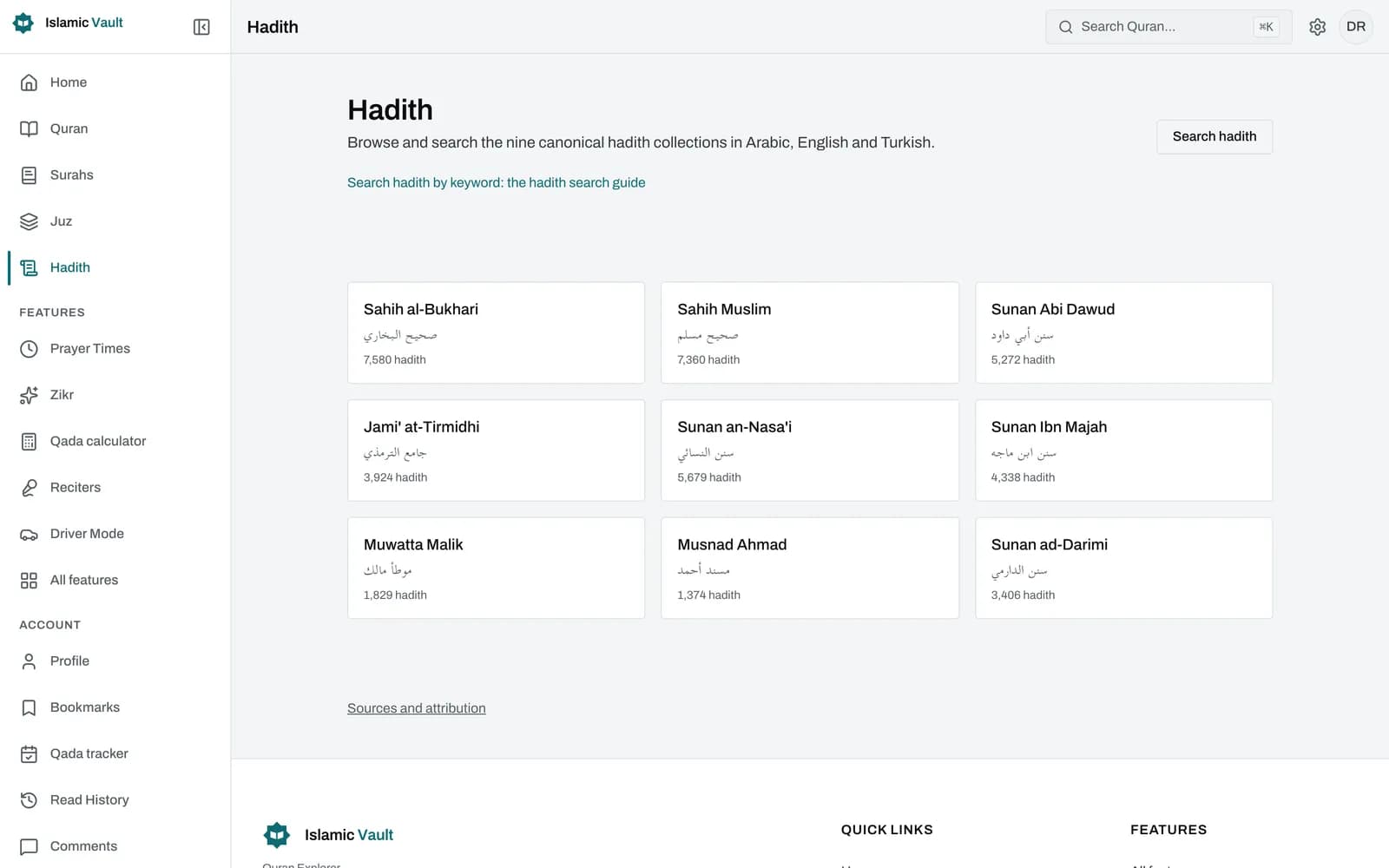
You can search nine major collections: the Six Books (Bukhari, Muslim, Abu Dawud, Tirmidhi, an-Nasa'i and Ibn Majah) plus Muwatta Malik, Musnad Ahmad and Sunan ad-Darimi. Together they hold 40,762 hadith in Arabic, and eight of the nine also have an English translation you can read and search.
Sahih al-Bukhari, compiled by Muhammad ibn Ismail al-Bukhari, has 7,580 hadith. Sahih Muslim, by Muslim ibn al-Hajjaj, has 7,360. Sunan Abi Dawud, by Abu Dawud Sulayman ibn al-Ash'ath as-Sijistani, has 5,272. Jami' at-Tirmidhi, by Muhammad ibn Isa at-Tirmidhi, has 3,924. Sunan an-Nasa'i, by Ahmad ibn Shu'ayb an-Nasa'i, has 5,679, and Sunan Ibn Majah, by Muhammad ibn Yazid Ibn Majah, has 4,338.
The three further collections are Muwatta Malik by Malik ibn Anas (1,829 hadith), Musnad Ahmad by Ahmad ibn Hanbal (1,374 in our current dataset, which is missing some chapters upstream) and Sunan ad-Darimi by Abdullah ibn Abd ar-Rahman ad-Darimi (3,406). Sunan ad-Darimi is available in Arabic only, because no translation exists in the source data. Turkish translations cover the Six Books and Muwatta Malik.
You can also browse each collection book by book. If the site is set to a language other than Arabic, English or Turkish, hadith text appears in English with a short notice.
What do the hadith grades sahih, hasan and da'if mean?
A grade is a scholar's assessment of how reliably a hadith was transmitted. Sahih means authentic, with a sound, connected chain of trustworthy narrators. Hasan means good and acceptable, with a slightly lesser degree of narrator precision. Da'if means weak, because of a defect in the chain. Mawdu marks a report judged to be fabricated.
The grades you see are labels taken from the source data, not rulings made by Islamic Vault. For Sunan Abi Dawud, Jami' at-Tirmidhi, Sunan an-Nasa'i and Sunan Ibn Majah they mostly come from scholars such as Al-Albani, Ahmad Muhammad Shakir and Abu Ghuddah, with others like Shuaib Al Arnaut and Zubair Ali Zai. Muwatta Malik carries grades by Salim al-Hilali.
Sahih al-Bukhari and Sahih Muslim are shown as Sahih because scholars broadly regard these two collections as authentic as a whole. Musnad Ahmad and Sunan ad-Darimi have no grades in the source data, so their hadith appear as ungraded.
Scholars sometimes reach different verdicts on the same hadith, and a grade alone does not settle how a text is applied. Treat the grade as a starting point and consult a qualified scholar for questions of practice. This page is general guidance, not a fatwa.
How do you search hadith effectively?
Search with the distinctive words you expect in the text. A query in Arabic letters searches the Arabic text, and a query in Latin letters searches the English translation. The two do not mix, so if an English search finds nothing, try the key Arabic word instead, or a different English word for the same idea.
Arabic search ignores diacritics and common letter variants, such as the different forms of alef, ta marbuta and ya, so you can type without harakat. English search matches word forms, so "pray" also finds "praying" and "prayed". When the site language is Turkish, Latin queries search the Turkish translation as well, listed first.
This is full-text search, not an AI that answers questions. It looks for the words you type, ranks the matches by relevance and shows the top 30, so a short, specific query usually works better than a whole sentence. Spelling is not corrected automatically. To find a hadith by topic, search for a word that would appear in it, such as "intention", "neighbour" or "charity", then add a collection filter if you get too many results.
How do you cite a hadith correctly?
Cite a hadith by its collection and number, for example Sahih Muslim 1349. Every hadith page shows this reference, and the page address follows the same pattern, so the reference and the link always point to the same text. Add the grade when it matters for your point, and mention who graded it.
Our numbers come from the source dataset. Other editions and websites sometimes number the same collection differently, so if you compare with a printed book or another site, check the Arabic text rather than relying on the number alone. Each hadith page also links to sunnah.com so you can cross-check.
If you spot an error in a text, translation or grade, use the Report an issue link on the hadith page. You do not need an account, and every report is reviewed by hand.
Where does the hadith text come from?
The text comes from two open datasets: fawazahmed0/hadith-api as the main source, and AhmedBaset/hadith-json for Musnad Ahmad and Sunan ad-Darimi. The sources page lists the exact versions used, the date they were fetched, their licence and every known gap, so you can see precisely what is and is not included.
Known gaps are stated openly: Musnad Ahmad is missing chapters 8 to 30 in the source data, Sunan ad-Darimi has no English translation, and nine entries in Sahih al-Bukhari were empty placeholders upstream and were left out.
The feature covers the text, translation, grade and reference of each hadith. It does not show full chains of narration (isnad), commentary (sharh) or legal rulings. For the people who passed hadith on, see the hadith narrators pages.
Sources and method
Frequently asked questions
How can I search for a hadith by keyword or topic?
Open hadith search and type a word that would appear in the hadith, in English or Arabic, using at least two characters. You get the 30 most relevant matches with the matching words highlighted. For a topic, try a key word such as "fasting" or "orphan" and filter by collection if needed.
How do I know if a hadith is sahih, hasan or daif?
Each hadith shows a grade badge: Sahih, Hasan, Da'if or Mawdu. For most of the Sunan collections the grade comes from named scholars such as Al-Albani. Bukhari and Muslim are shown as Sahih because the collections are accepted as authentic. Musnad Ahmad and ad-Darimi have no grades in the data.
Which hadith collections can I search?
Nine: Sahih al-Bukhari, Sahih Muslim, Sunan Abi Dawud, Jami' at-Tirmidhi, Sunan an-Nasa'i, Sunan Ibn Majah, Muwatta Malik, Musnad Ahmad and Sunan ad-Darimi. All are in Arabic. Eight have an English translation (not ad-Darimi), and seven have a Turkish one.
How do I find a hadith by its number in Bukhari or Muslim?
Open the collection and go to the number, or use the address directly, for example /en/hadith/muslim/1349 for Sahih Muslim 1349. Numbers follow our source dataset, which can differ from some printed editions, so compare the text if a number does not match.
What is the difference between Sahih al-Bukhari and Sahih Muslim?
Both are collections that scholars broadly regard as authentic, compiled by Muhammad ibn Ismail al-Bukhari and by Muslim ibn al-Hajjaj. They are separate works with their own arrangement and selection. In our dataset Bukhari has 7,580 hadith and Muslim 7,360.
How can I check the source and reference of a hadith?
Every hadith page shows its collection and number and links to sunnah.com. The hadith sources page lists the datasets, the exact versions and licence, and the known gaps. If something looks wrong, use Report an issue on the hadith page.
Can I search hadith in Arabic without diacritics?
Yes. Arabic search ignores harakat and folds common letter variants such as the forms of alef, ta marbuta and ya, so a plain query finds vowelled text. Arabic queries search only the Arabic text, and English queries search only the translation.
Related features
Read hadith by the Companion who narrated them: Abu Huraira, Aisha, Ibn Umar and more. Free narrator pages; about 86% of our hadith are linked to a narrator.
Read all 114 surahs of the Quran online in Arabic with English translation and transliteration. Choose from 50+ translations in 30+ languages, free.
Bookmark any ayah or whole surah, sort your favorite verses into your own folders and open them again on the web and in the Islamic Vault mobile app.
Keep your progress in one place
Create a free account to save your progress and pick up where you left off. Or start exploring now, no account needed.